


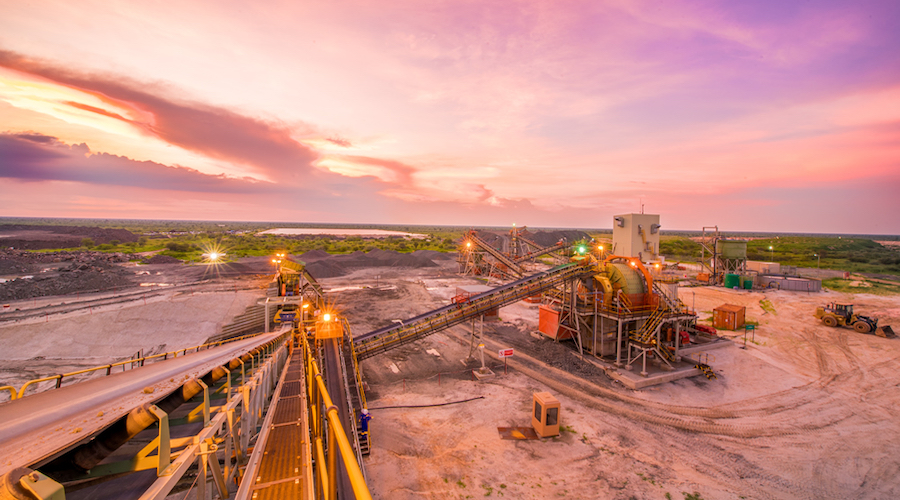
Higher diamond prices and tighter cost controls have helped Gem Diamonds return to profitability, despite lower production volumes at its flagship Letšeng mine in Lesotho.
Gem Diamonds has returned to profit in the first half of 2026, demonstrating the resilience of its high-value diamond strategy at a time when the broader natural diamond market continues to face significant pressure.
The London-listed producer reported an attributable profit of US$600,000 for the six months ended 30 June 2026, a substantial turnaround from the US$11.7 million loss recorded during the corresponding period in 2025. Revenue increased by 32% to US$59.7 million, supported primarily by stronger prices achieved for diamonds from its Letšeng mine in Lesotho.
The recovery is particularly notable because it was achieved despite lower diamond production. Letšeng recovered 41,695 carats during the first half, down 12% from 47,125 carats a year earlier. However, the average selling price increased by 38% to US$1,395 per carat, compared with US$1,008 per carat in H1 2025.
High-value stones underpin performance
The results highlight the importance of Letšeng’s distinctive production profile. Located in Lesotho’s Maloti Mountains, the mine is renowned for producing large, exceptional-quality white diamonds and is described by Gem Diamonds as the highest dollar-per-carat kimberlite diamond mine in the world. Gem Diamonds owns a 70% interest in the operation.
During the first half of 2026, Letšeng produced three diamonds larger than 100 carats. One of the most significant recoveries was a 346.99-carat white diamond, named the Lesotho Jubilee to commemorate Lesotho’s 60th anniversary of independence. The stone was scheduled for sale after the reporting period.
The mine also achieved a peak price of US$32,908 per carat for a 52.24-carat white diamond. Eight diamonds sold during the period generated more than US$1 million each, collectively contributing US$16.1 million in revenue.
These results illustrate the value proposition behind Letšeng’s large-stone strategy: lower volumes can be partly offset when the operation recovers and sells exceptional diamonds capable of commanding significant premiums.
Cost reduction strengthens the balance sheet
Improved diamond prices were only part of Gem Diamonds’ recovery.
The company said structural cost measures introduced through its Business Resilience Programme in July 2025, together with an extension of royalty relief at Letšeng, have materially reduced its cost base. The benefits were reflected in a turnaround in underlying earnings, with underlying EBITDA rising to US$8.6 million, compared with a negative US$2.6 million in the first half of 2025.
The company has also significantly strengthened its financial position. Cash on hand stood at US$20.2 million at 30 June, compared with US$3.8 million at the end of December 2025, while net debt fell sharply from US$20.1 million to just US$500,000.
The improvement comes as Gem Diamonds continues to operate in a challenging market environment, making cost discipline and cash preservation important components of its strategy.
Managing the transition between ore sources
One of the key operational challenges facing Letšeng is the changing contribution from its two principal ore sources.
During H1 2026, production was weighted towards the Main Pipe, which generally contains lower-grade and lower-value material than the Satellite Pipe. The Main Pipe accounted for approximately 84% of ore treated during the period, compared with 68% in H1 2025. At the same time, Satellite Pipe material accounted for only 16% of ore treated, down from 32% a year earlier.
Overall ore treated nevertheless increased by 4% to approximately 2.6 million tonnes, while waste stripping fell by 82% to about 308,000 tonnes. The lower contribution from higher-grade Satellite Pipe material was the principal reason for the decline in recovered carats and grade.
For the remainder of 2026, production is expected to come exclusively from the Main Pipe while preparations continue for the next Satellite Pipe cutback. Under the current mine plan, higher-value Satellite Pipe ore is not expected to become available until 2031, although Gem Diamonds is investigating alternative mining methods that could bring forward access.
Natural diamonds face a changing market
Gem Diamonds’ performance comes against a difficult backdrop for the global diamond industry.
Prices for smaller and lower-quality rough diamonds have been particularly affected by the growing availability of laboratory-grown diamonds, while broader macroeconomic uncertainty has also weighed on demand and pricing. Gem Diamonds says the company’s larger, high-quality stones have been less exposed to these pressures, with demand for Letšeng’s exceptional diamonds remaining encouraging during the first half.
This creates an important distinction within the natural diamond market. While producers focused heavily on smaller or lower-value stones have faced severe pricing pressure, Letšeng’s geological characteristics provide exposure to a segment where scarcity, size and quality continue to command a premium.
For Gem Diamonds, however, the challenge will be maintaining that resilience while the mine operates through a period in which the higher-value Satellite Pipe contributes less to production.
Focus turns to sustainable recovery
Gem Diamonds’ immediate strategy is therefore centred on maintaining the cost reductions achieved through its Business Resilience Programme, protecting cash and operating Letšeng safely and efficiently.
The company is also engaging with lenders over the renewal or extension of its revolving credit facilities, which are due to expire in December 2026.
Longer term, the company believes that tightening natural diamond supply and favourable demand fundamentals could support rough diamond prices, particularly for high-quality stones. Its 2025 annual report notes that the current mine plan requires reliance on lower-value Main Pipe ore until the end of 2030, making the timing of future Satellite Pipe access an important consideration for the operation’s economics.
For Lesotho, Letšeng’s performance also remains significant beyond Gem Diamonds’ own balance sheet. The mine is an important contributor to the country’s economy and public finances. Gem Diamonds reported that Letšeng contributed US$25.4 million in taxes, royalties and mining lease payments to the Lesotho fiscus during 2025.
The first-half turnaround therefore represents more than a return to a small statutory profit. It demonstrates how a mining operation with a differentiated orebody and exposure to scarce, high-value products can use pricing strength, operational discipline and cost restructuring to navigate a difficult commodity cycle.
For Gem Diamonds, the next test will be whether those measures can sustain the business through the lower-value Main Pipe period while it works to unlock earlier access to Letšeng’s higher-value Satellite Pipe ore.