

By James Clarke, CEO, PPU Umwelttechnik GmbH (ClearFox®)
Ask a mine manager about water and the conversation turns quickly to the streams everyone expects: process water from the plant, tailings water, pit dewatering, and the contaminated runoff that has to be captured and controlled. These are rightly the focus of enormous engineering effort and capital. Yet on almost every remote site there is another wastewater stream that receives a fraction of the attention it deserves — the sewage generated by the people who live and work there.
The wastewater everyone forgets
A modern worker camp is, in effect, a small town that has been dropped into a remote landscape. It has kitchens, ablution blocks, laundries and accommodation, and it produces domestic wastewater accordingly. In most camps the two domestic streams — black water from toilets and grey water from showers, sinks and laundries — are collected and treated together, which is sensible but concentrates the load.
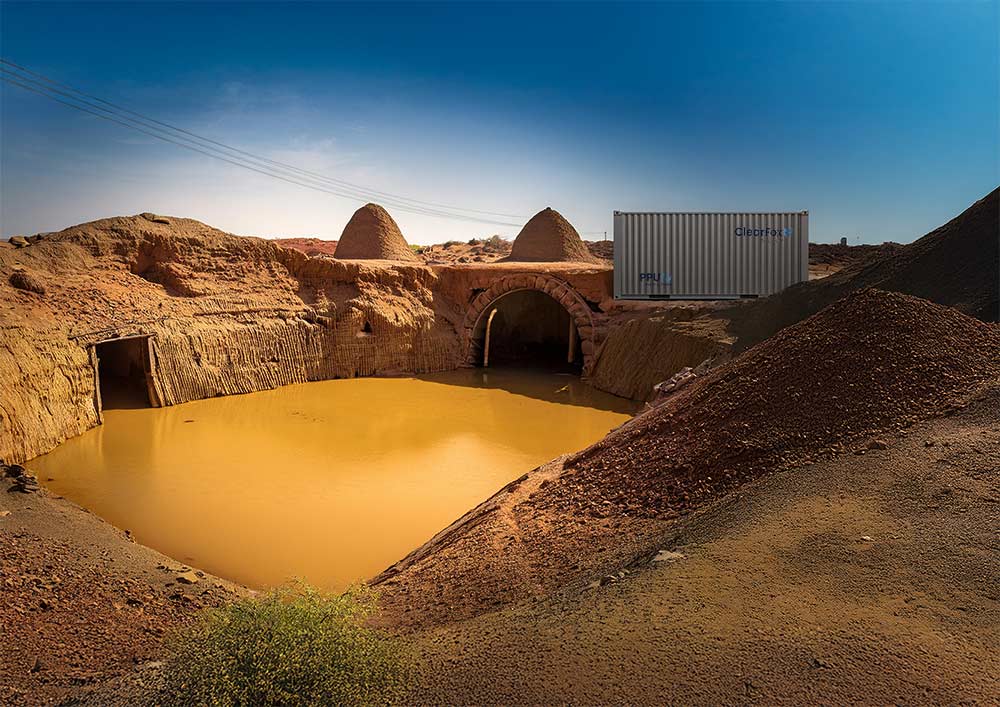
What surprises many operators is just how strong that combined stream can be. On-site catering is usually the culprit. Feeding a workforce around the clock introduces food waste, fats, oils and grease into the drains, and these push the organic load well above that of ordinary municipal sewage. A system sized as if it were handling a quiet residential suburb will struggle. Sewage flows in a camp are rarely constant either — they peak sharply in the mornings, after shifts and around mealtimes — so the treatment process has to absorb both hydraulic and organic swings without losing performance. Get the design assumptions wrong and the result is non-compliance, odour and failure exactly where a mine can least afford it.
One platform, from a hundred people to twenty thousand
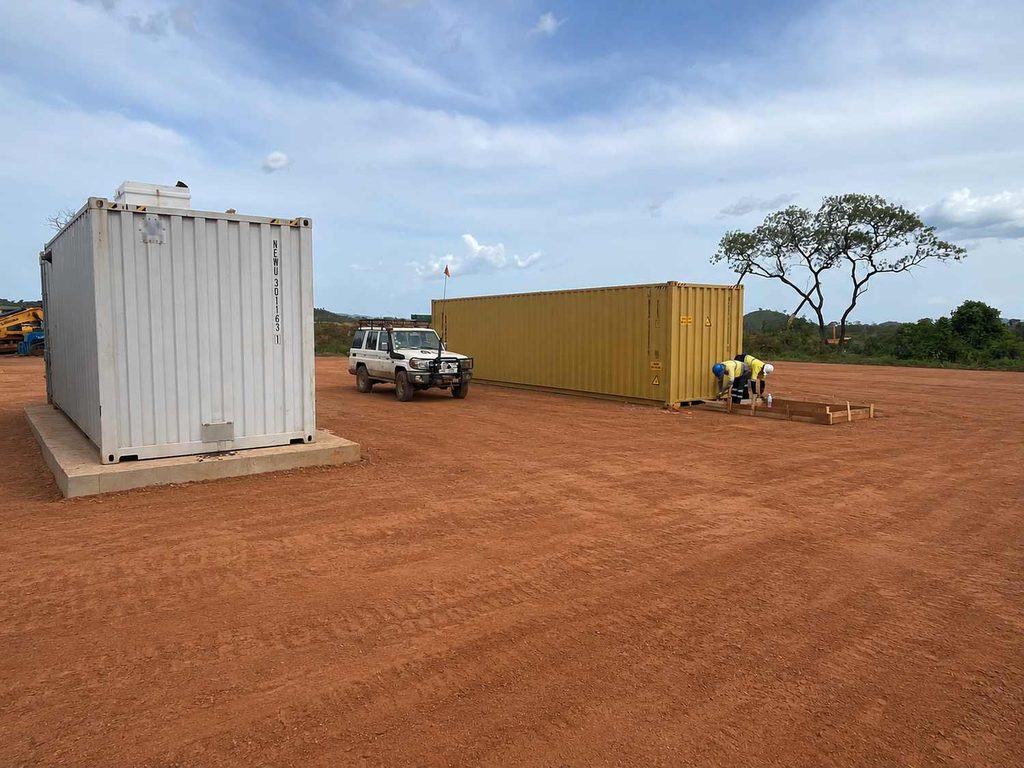
This is the problem containerized and modular systems were built to solve. The same core technology scales from a small forward camp of around a hundred people up to major operations housing twenty thousand, simply by adding modules. The systems arrive pre-assembled and factory-tested inside ISO shipping containers, delivered ready for fast installation — no long civil-works programme, no large concrete footprint, and no drawn-out commissioning that falls out of step with the mine’s own schedule.
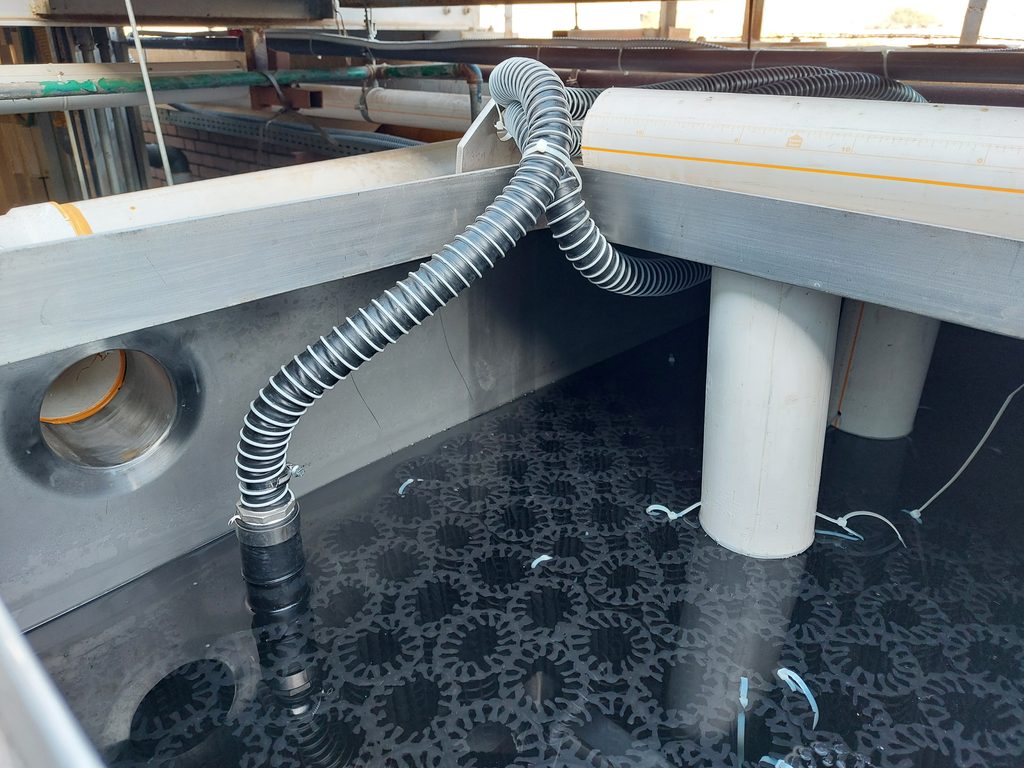
At the heart of the plant is a fixed-bed biological process in which micro-organisms grow as a biofilm on carrier media and break down the organic load naturally, without chemicals. A buffer stage balances the peaks so the biology is fed at a steady rate, and the modular layout means capacity can be added as a camp grows. Because the whole system is containerized, it can also be relocated when a camp moves or closes — an important consideration for operations with a finite life.
Proven from the desert to the ice — and at altitude
Remote mining sites impose conditions that would defeat a conventional plant, and the technology has been proven across the full range of them. Containerized systems have been delivered for worker-camp treatment in extreme heat, including desert camps in Libya, where integrated climate control keeps the biological process within its working temperature range. At the opposite extreme, containerized systems are installed at the South Pole in Antarctica — about as hostile an environment as exists on Earth.
Altitude brings its own challenge. Many mines sit at considerable elevation, and where wastewater is treated fully biologically the process depends on supplying enough oxygen for the bacteria to thrive. Thinner air changes that calculation, and the plant has to be designed with it in mind. Accounting for climate, altitude and site logistics from the outset is precisely what separates a system that works in a brochure from one that works on a mountainside.
From liability to resource
The most important shift in thinking is to stop treating camp sewage as a problem to be disposed of and start treating it as a resource. Mines are frequently located in water-scarce regions, where every litre of fresh water carries a real cost. Once the wastewater has been properly treated, it does not have to be thrown away. It can be reused on site for applications that consume large volumes of water but do not require potable quality — dust suppression on haul roads and stockpiles being an obvious example, along with toilet flushing and irrigation of green areas. Water that was a compliance liability becomes a way to reduce freshwater draw, ease pressure on local supplies, and strengthen the sustainability credentials that regulators, investors and host communities increasingly demand.
Compliance: a moving target
Reuse is attractive, but for most miners the immediate driver is compliance — and compliance in this sector is anything but uniform. Effluent standards differ significantly from one country to the next, and they differ within a single country depending on the sensitivity of the location. A camp discharging near a river, an aquifer, a fishery or a protected area will face far tighter limits than one in an isolated, low-sensitivity setting. There is no single specification that fits every site.
For that reason, the right approach is rarely an off-the-shelf box. It is a customized solution engineered around the specific discharge target, the local regulations and the conditions of the individual site, backed by a guarantee on the effluent quality it will achieve. The modular philosophy makes this practical: the same proven building blocks are configured differently — with additional treatment stages for nutrients, disinfection or filtration — to hit whatever standard the location demands.
An African footprint built on customized solutions
Nowhere is that variability more apparent than across Africa, where companies like ClearFox have delivered site-specific solutions in Mali, Sierra Leone, Ivory Coast, Tanzania, Nigeria, South Africa, Kenya and Ghana, among others. In Mali alone, projects have ranged from a self-sufficient mobile plant treating sanitary wastewater at a remote gold-mining workers’ village to a highly efficient lamella clarifier handling the mixed dust-, grease- and oil-laden wastewater collected at a mining camp. Each of these began not with a catalogue but with the specific challenges of the site, and each was engineered accordingly.
When CapEx is the obstacle
Not every operator can, or wants to, commit major capital expenditure to a permanent plant — particularly during construction, ramp-up or short-life operations. For those situations some companies maintain a rental fleet that can be mobilised at very short notice, giving a mine compliant treatment capacity without a large upfront investment and with the flexibility to scale up or down as the camp changes.
The value of that flexibility was demonstrated recently at a large mine in Guinea, in West Africa, where rapid expansion of the camp left the existing treatment systems under severe pressure. Rather than wait months for new permanent infrastructure, ClearFox shipped in rental units at short notice to expand capacity and keep the site compliant while it grew — turning a potential bottleneck into a manageable, staged upgrade.
The stream worth taking seriously
Mining generates many kinds of wastewater, and the industry has rightly invested heavily in managing its process and tailings streams. But domestic sewage from worker camps sits alongside them as a genuine, and often underestimated, compliance risk — one where standards are inconsistent, loads are higher than they appear, and the consequences of getting it wrong land squarely on the operator. Treated well, with the right containerized, modular and site-specific engineering, that same stream becomes something better than a liability: a reliable route to compliance, a source of reusable water, and a visible commitment to operating sustainably. For mining companies, it is a critical piece of the water picture that is well worth bringing in from the margins.
James Clarke is CEO of PPU Umwelttechnik GmbH, the German manufacturer behind the ClearFox® range of containerized and modular wastewater treatment systems, deployed in more than 50 countries.
For more information visit: ClearFox