

Battery Energy Storage Systems are rapidly reshaping the power supply landscape, emerging as the cornerstone of energy‑efficient solutions worldwide. Atlas Copco Power Technique’s advanced Energy Storage Systems, with integrated Li‑ion battery technology, stand at the forefront of the energy transition, driving operational sustainability by delivering reliable, flexible, long-duration power that ensures continuity in demanding applications where constant, high‑capacity energy flow is critical.
These Energy Storage Systems from Atlas Copco are the very definition of low Total Cost of Ownership (TCO). Engineered to efficiently store and deliver energy to match load demand, the systems are ideal for off‑grid applications and reinforcing limited grid capacity. They are equally adept at handling applications with a high energy demand and variable load profiles, balancing both low loads and peaks with efficiency. Designed to work both independently and in synchronised setups, they form the heart of decentralised hybrid systems with multiple energy inputs – from the grid and renewables to power generators. Whether deployed as standalone units, integrated in hybrid mode with grids, renewables or generators, or serving as the central hub of a microgrid, these industry‑leading range of Lithium‑Ion Energy Storage Systems empowers operators to optimise energy use, cut costs and boost productivity. Operators can synchronise several models to create resilient microgrids, storing and delivering energy from diverse sources, including renewables.
“Our compact, robust Energy Storage Systems are rewriting the power narrative, delivering operational efficiency, fuel and emission economies and flexible, scalable solutions that unlock reliable energy across industries,” asserts Atlas Copco Business Line Manager, David Stanford. “When coupled with a generator, these systems manage low loads so efficiently that running hours are reduced by up to 70%, extending generator lifetimes by five to ten years, delivering tangible savings and reliability for end‑users. Even more impressively, in standalone operation or when paired with the grid and/or renewables, the units consume no fuel at all! In hybrid solutions with power generators, our Energy Storage System can reduce daily fuel consumption by up to an unrivalled 90%, dramatically lowering costs and emissions.”
“Lithium-Ion Energy Storage Systems are transforming the way power is deployed, expanding the spectrum of suitable applications and opening up new horizons across industries while giving operators unprecedented flexibility,” observes Stanford and he outlines the principle behind this efficient battery technology: “Within the cell, electrolytes carry positively charged lithium ions between the anode and the cathode through the separator. When the battery is powering a device, the anode releases lithium ions to the cathode, creating a flow of electrons. In rechargeable batteries, this flow reverses during charging; the cathode releases lithium ions which are then received by the anode.”
As Li‑ion battery‑based systems recharged solely by renewable sources, they deliver regulation‑compliant performance that meets stringent emission norms during operation. In hybrid setups with fossil energy sources, they proportionally cut CO₂ emissions i.e. produce no emissions in line with fuel savings, depending on the application or load profile. Their inherently quiet operation makes them ideally suited for noise‑sensitive environments.
“Combined with our integrated ECO Controller™, Atlas Copco’s in‑house developed Energy Management System (EMS), which intelligently adjusts the power offering to match demand based on the load profile, Energy Storage Systems enable operators to decarbonise their operations while achieving significant fuel, energy and lifecycle savings,” adds Stanford.
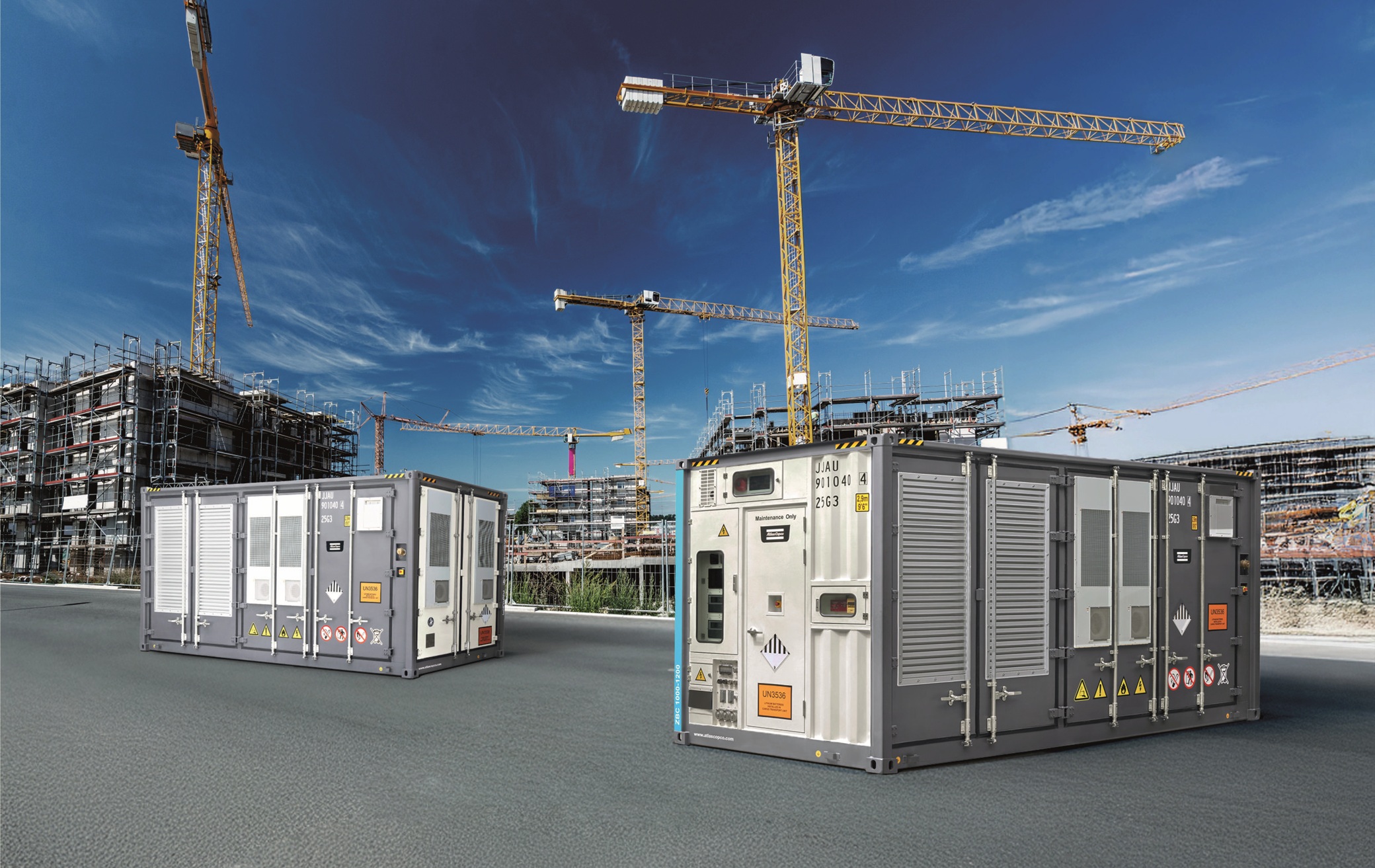
Atlas Copco’s Energy Storage Systems portfolio includes the extra‑small 2 to 10 kVA units, the 15 to 150 kVA Canopy range and the top of this range 200 to 1200 kVA ZBC Container series. As the largest Container Energy Storage System in the prime power market, this next-generation ZBC 1000‑1200 stands out as a true game‑changer, delivering 1 MW of power output and 1.2 MW of energy capacity from a single unit, all conveniently packed into a compact container.
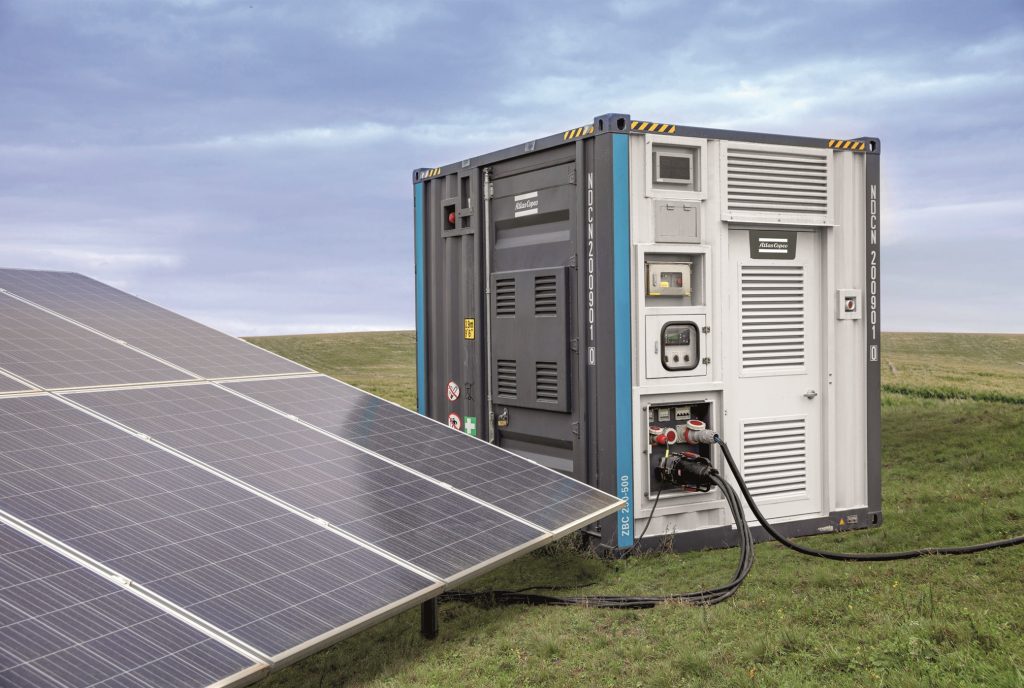
The flagship ZBC 1000‑1200 is engineered for durability and performance, featuring an improved LFP battery management system and trusted LiFePO4 Lithium‑Ion Phosphate technology that ensure incredible reliability and a long operating life. Thanks to this advanced Lithium‑Ion Phosphate battery design, the system is up to 70% more compact and lighter in weight, delivering a robust, easily transportable solution with an expected lifetime of up to 6 000 cycles.
For additional durability, the ZBC 1000‑1200 includes an advanced thermal management HVAC system, ensuring lasting power while withstanding extreme conditions from ‑20 °C to +50 °C. The system sustains high performance even at higher altitudes and incorporates extra winterization to withstand harsh climate challenges. Moreover, the Container integrates precise temperature control within the battery compartment and advanced fire suppression for safe, dependable operation. Demonstrating true plug‑and‑play capability, the system is quick to install and connect, ready for use while saving time, manpower and costs.
Designed to be both flexible and scalable, the ZBC range can be synchronized in parallel – up to 16 units (≤ 500 kVA) and up to 8 flagship ZBC 1000‑1200 units (> 1000 kVA). This capability enables the creation of a microgrid in the most efficient way, particularly when the available energy sources are renewable options. Reducing the number of generators needed on a construction site for example lowers fuel consumption and CO₂ emissions.
When ZBC units are seamlessly integrated with the ECO Controller™, operators remain in full control of their temporary power applications. Complementing this, FleetLink, Atlas Copco’s intelligent telematics solution, optimises fleet utilisation by providing smart insights and remote monitoring in real-time for maximum efficiency and performance. The ZBC range elevates modular storage to a new level, proving ideal for demanding applications typically found on construction, mining and port sites, events, rental and critically, emergency power where reliability is non‑negotiable.
By combining efficiency with scalability, Atlas Copco’s compact Energy Storage Systems expand the options for reliable power, unlocking smarter, more sustainable solutions tailored to diverse energy demands. These systems can properly size cranes and other electric motors, while their low‑noise operation makes them ideal for managing peaks in energy demand at EV recharging stations and noise‑sensitive environments such as events or indoor settings. In addition to They delivering resilient, responsible energy on demand for sectors including construction, telecoms, manufacturing, mining and oil & gas sectors, these Energy Storage Systems extend their versatility into rental applications, ensuring performance wherever reliable power is paramount.
For more information please visit: Atlas Copco