
Australian explorer 88 Energy and its partners are preparing to commit at least US$10 million to further exploration on Namibia’s PEL 93 over the next two years, with the programme expected to include the drilling of an exploration well.
The proposed investment marks a significant step forward for the onshore Owambo Basin project and could move PEL 93 from extensive geological and geophysical evaluation towards direct testing of its highest-priority targets.
The commitment is contained in the proposed second renewal period for PEL 93, which the joint venture has applied to enter from 3 October 2026. The current exploration period expires on 2 October.
According to 88 Energy’s latest half-year report, the proposed two-year renewal would carry a minimum gross joint-venture exploration expenditure commitment of US$10 million, including preparation for and drilling of at least one exploration well.
The renewal application was submitted to Namibia’s Ministry of Industries, Mines and Energy on 29 June.
Lead 9 emerges as priority drilling target
The proposed exploration programme follows several years of geological and geophysical work across PEL 93, with the partners now concentrating their efforts on the most prospective areas within the licence.
Operator Monitor Exploration has integrated new aerogravity, magnetic and radiometric data with historical 2D seismic, passive seismic and other legacy datasets. The programme included approximately 200 line-kilometres of 2D seismic work and a further 6,043 line-kilometres of high-resolution gravity, magnetic and radiometric surveying completed during the first quarter of 2026.
The results have strengthened the structural interpretation of the licence and identified Lead 9 as the leading candidate for future drilling.
Monitor refers to the target as Prospect 9, while 88 Energy identifies it as Lead 9. The structure covers an interpreted area of approximately 100 square kilometres and has advanced towards drill-ready status.
Monitor has attributed potential recoverable oil of more than one billion barrels to Prospect 9, although the estimate remains an exploration target and would need to be tested through drilling.
The broader PEL 93 portfolio currently includes 13 leads and one prospect, with stacked targets identified across multiple stratigraphic levels. The Otavi carbonates represent the principal exploration objective, while the Kombat sandstones are among the secondary targets under consideration.
Environmental assessment work for drilling is expected to begin during 2026 as the partners advance preparations for the proposed well.
Drilling could come in 2027
Subject to approval of the second renewal period, Monitor has indicated that preparations are progressing towards a first exploration well in the second half of 2027.
The timing remains dependent on regulatory approvals, joint-venture decisions and completion of the required environmental and technical work.
Nevertheless, the proposed US$10 million commitment provides a clearer indication of the scale of exploration that could take place on PEL 93 over the coming two years.
For 88 Energy, however, the commitment does not translate into a US$10 million direct funding requirement.
The company holds a fully earned and unconditional 20% working interest in the licence. Its identified share of the firm work programme and budget through 30 June 2027 is approximately US$98,000, while its share of the licence bond would be about US$267,000 if the renewal is approved.
This places 88 Energy’s identified near-term exposure at approximately US$365,000.
Expenditure associated with activities from July 2027, including the proposed exploration well, remains subject to further joint-venture and regulatory approvals.
Restructuring reduces 88 Energy’s exposure
The proposed programme follows a significant restructuring of 88 Energy’s participation in PEL 93 earlier this year.
The company amended its farm-in agreement with Monitor Exploration, securing its 20% interest on a fully earned basis while removing its Stage 2 and Stage 3 farm-in obligations.
The restructuring reduced 88 Energy’s minimum forward financial exposure by approximately US$15 million while allowing it to maintain exposure to the Namibian exploration opportunity.
Under the previous arrangement, 88 Energy was required to fund the first US$7.5 million of an initial exploration well—then estimated at approximately US$12 million—to increase its interest to 37.5%.
A further US$7.5 million carry towards a second well was contemplated under Stage 3, with the potential for the company’s interest to rise to 45%.
The removal of those obligations significantly changes the company’s financial position within the project.
Rather than being committed to substantial drilling carries, 88 Energy now retains a 20% interest while maintaining greater flexibility over future capital allocation.
The structure is particularly relevant as the company continues to prioritise its Alaska portfolio while retaining exposure to what could become a significant Namibian onshore exploration opportunity.
Licence footprint to be reduced
The proposed second renewal also involves a substantial reduction in the geographical footprint of PEL 93.
The joint venture intends to relinquish approximately 50% of the existing licence area, exceeding the statutory minimum relinquishment requirement of 25%.
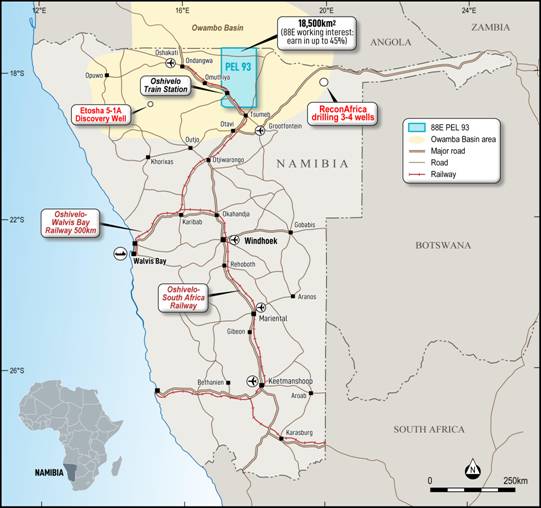
PEL 93 currently covers approximately 18,500 square kilometres in the Owambo Basin. If approved, the proposed relinquishment would reduce the area to roughly half its current size.
Importantly, the partners say the reduction would not result in the loss of any of the 13 prospects and leads currently considered prospective.
Instead, the strategy is designed to concentrate exploration activity on the areas supported by the strongest geological and geophysical evidence.
The smaller licence footprint should also provide modest cost savings and remove the need for further relinquishment during the proposed renewal period.
Funding options under consideration
As PEL 93 moves closer to drilling, the joint venture will need to consider how the more capital-intensive phase of exploration is financed.
88 Energy has indicated that potential funding routes could include third-party participation or the establishment of a Namibia-focused listed entity.
For now, the immediate focus is on completing the technical interpretation, ranking Lead 9 and the remaining prospects, advancing the regulatory process and determining the most appropriate funding structure for future exploration.
The proposed US$10 million programme therefore represents an important transition point for PEL 93.
After years of geological and geophysical work, the project is moving towards a phase in which the most compelling targets can potentially be tested by drilling.
If the renewal application and proposed relinquishment are approved, PEL 93 will enter its next exploration phase with a substantially smaller acreage position—but with the joint venture retaining the prospects and leads it believes offer the strongest potential for an onshore oil discovery.
For Namibia, the development adds another exploration programme to a rapidly expanding petroleum sector, while for 88 Energy and its partners, the proposed 2027 drilling campaign could provide the first major test of the geological model developed across the Owambo Basin licence.