

At the Qurayyat Independent Water Plant in Oman, failures in the offshore intake and outfall system threatened the reliability of the marine infrastructure the plant depended on.
The 200,000 m³/day seawater reverse-osmosis facility was partially commissioned in 2018, when significant failures emerged in the newly installed system. Two of the four large-diameter HDPE pipelines separated on the seabed, with sections floating to the surface. The plant continued operating partially through the compromised infrastructure, but full commercial operation could not be achieved. The marine works were one critical part of the client’s (QDC, an Iv3 Aqua Company) wider restoration program required to bring the facility to full commercial operation.
WSP was appointed at the end of 2020 to investigate what had gone wrong, understand the marine environment, and develop a resilient, cost-effective solution. There was one important constraint from the outset: the plant had to remain in operation while the marine system was rebuilt.
Understanding what failed
“Before designing a replacement, we needed a reliable picture of the infrastructure already in place. That was more difficult than it sounds,” said Marthinus Retief, Director & Deputy Sector Lead for Maritime, WSP in Africa. “This was a brownfield project, marine as-built information was incomplete, and some critical infrastructure was buried or inaccessible beneath the seabed. The condition of the remaining pipelines also had to be established because retaining suitable components could reduce construction risk and avoid unnecessary replacement.”
One of the most useful investigations involved an internal inspection of approximately 1.9 km of pipeline using a remotely operated vehicle with an extremely long tether of more than 2 km. Limited access points, tidal conditions, and the need to keep the plant operating all had to be accommodated.
The inspection revealed important information about the existing system, including level discrepancies introduced during the original construction. These findings were incorporated into WSP’s hydraulic design and helped the team determine which parts of the system could safely remain in place.
The investigation also informed a wider trade-off process in which 11 potential solutions were developed, costed and assessed. The preferred approach ultimately balanced future operating risk with the practical risks of marine construction.
Designing for an unforgiving marine environment
Understanding the sea itself was just as important as understanding the failed infrastructure. WSP gathered real-time metocean data and developed numerical oceanographic models to simulate waves, currents, and other loading conditions. The design had to account for extreme conditions associated with tropical cyclones as well as potential tsunami waves originating from the Makran subduction zone north of the Gulf of Oman.
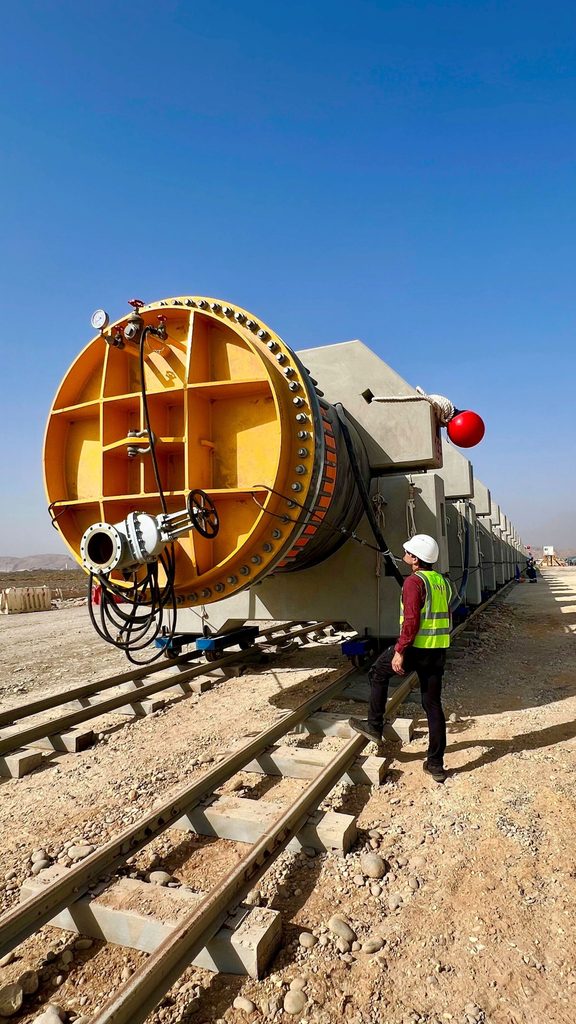
The final solution involved rebuilding two 2.5m-diameter intake pipelines and two 1.8m-diameter outfall pipelines. Each new HDPE line extends for approximately 900m offshore, terminating at an intake structure or brine diffuser.
“Hydrodynamic stability was a key consideration because the design loading varies along the pipelines with water depth, pipe angle, and wave behaviour. Concrete weight collars were therefore used to stabilise the pipelines on the seabed,” said Retief.
The two offshore intake towers presented another challenge. Each structure is approximately 5.8m in diameter, 12.4m high and weighs around 230 tonnes. They were designed for installation in three segments rather than as single units, reducing the size of marine lifting equipment required. That approach saved construction time and cost but required the connections between the segments to reliably transfer significant wave loading.
Engineering around the unexpected
Marine projects rarely unfold exactly as the drawings suggest, particularly when working around existing infrastructure. Subsequent information and discussions with the client prompted and allowed the search for alternative pipeline connection locations to the specified coordinates initially planned.
“The locations of four buried offshore pipeline flanges were initially unknown. Our team, together with the client and contractor pieced together partial historical records, diver accounts, previous construction photographs, ROV data, and satellite imagery to narrow down their likely positions,” said Gerhard Kapp, Resident Engineer on the project site.
The contractor successfully managed to expose the existing flanges and WSP revised the connection strategy and designed spool pieces with sufficient tolerance to accommodate alignment differences between the older and new pipeline systems. This reduced both construction and programme risk.
A separate problem emerged during procurement of the large-diameter HDPE pipe. Only a small number of suppliers globally could manufacture the required size to the applicable international standards. When the selected supplier suffered a major tooling failure, the estimated delay to repair their equipment threatened to add months to the programme.
The client, contractor, supplier and engineering project team worked collaboratively to qualify and modify an alternative extrusion facility in Egypt. The solution allowed suitable pipe to be produced without any negative effect on the programme, quality, or cost.
Keeping water flowing through construction
Rebuilding the marine system also meant managing environmental and operating risk around an active desalination plant.
WSP developed dynamically coupled near-field and far-field hydrodynamic models to assess how concentrated seawater discharged from the plant would mix and disperse in the marine environment.
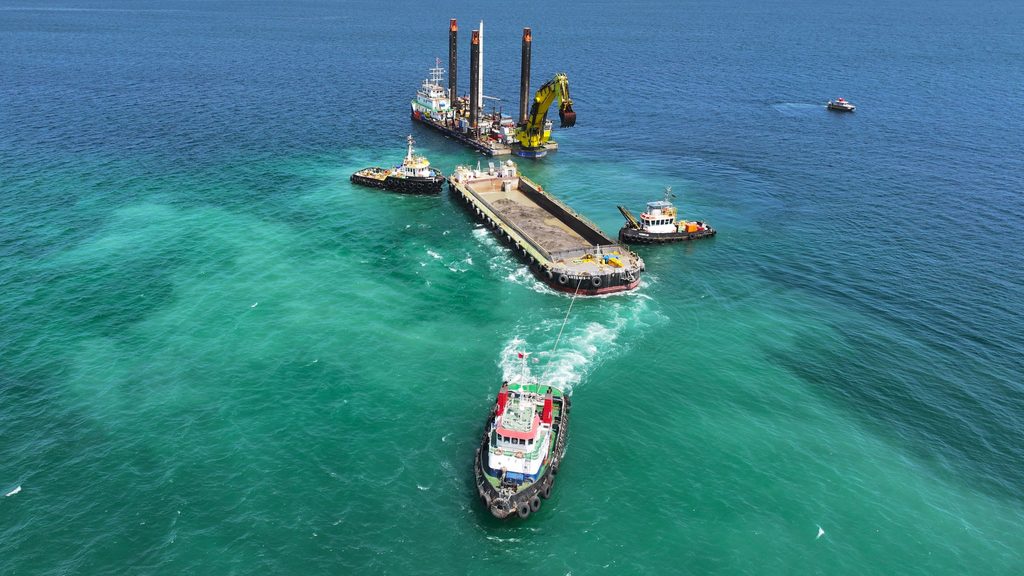
Construction required approximately 240,000m³ of seabed dredging for installation of the four pipelines. Elevated turbidity created by dredging could not be allowed to affect the temporary intakes supplying the operating plant. Continuous offshore monitoring stations and heavy-duty silt curtains were used to track and control that risk.
“No plant production was lost as a result of the dredging works, and the project recorded no noteworthy environmental incident during the 20-month construction period,” said Kapp.
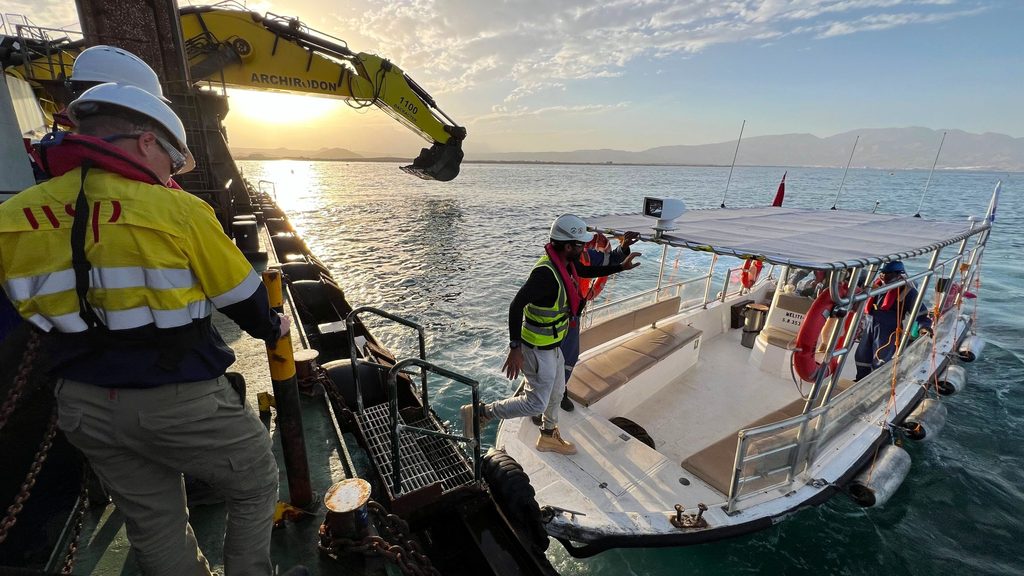
Safety was equally demanding. The works involved extensive underwater work by divers, heavy marine plant, underwater connections, and construction beside operating infrastructure. Thanks to collaborative work, good communication and a proper appreciation by all parties of the risks involved, the project reached completion, exceeding one million safe man-hours, with zero Lost Time Injuries.
The four new seabed connections were completed six days earlier than scheduled, allowing commercial-operation testing to begin sooner than planned. Official Commercial Operation Date was achieved on 28 November 2025, 92 days ahead of the required date. The plant is now fully operational. The marine works formed a substantial component of the broader restoration works, which had a total value of approximately US$80 million and were required for the facility to meet commercial operation.
All design work, technical services, and contract management were undertaken by WSP’s Maritime team in South African, which also provided the Resident Engineer, Assistant Resident Engineer, and principal marine site inspectors. WSP’s local Oman branch was involved for other site support, including HSE. The Client (QDC, an Iv3 Aqua Company) played an engaged and vital role in the success of the project due to their commitment to ensuring quality data is obtained to inform design, as well as high level of collaboration during the initial work and construction process. Similarly, the Contractor (Archirodon SPC) along with their suppliers consistently illustrated their marine construction expertise, commitment to quality, programme and safety, and thereby were key to the success of the project.
The Qurayyat Independent Water Plant Marine Works project was selected as a finalist and received the only Highly Commended award in the Technical Excellence – International Project of the Year category at the 2026 SAICE National Awards.
“This project required our team to understand a failed offshore system, redesign it around the constraints of an operating plant, and deliver the replacement infrastructure while maintaining plant operation. Today, the plant is fully operational and supported by a rebuilt marine system designed to withstand the conditions it faces,” concluded Retief.
WSP in Africa is hiring! To find out more about available opportunities, check out the Careers page on our website .wsp.com or look out for updates on our LinkedIn page, @WSPinAfrica