

A non-profit institute and thought leader on social dialogue is opening its Joint Problem-Solving Service (JPSS) to broader partner engagement, offering structured, neutral facilitation that resolves disputes between mining companies, host communities, organised labour and government before they escalate.
Johannesburg, 19 May 2026 — The Institute for Social Dialogue (ISD), a non-profit company established in 2022 to convene neutral, evidence-led dialogue in mining-affected communities, today invited partners across the mining sector, organised labour, civil society and government to engage with its Joint Problem-Solving Service (JPSS). The service is not new; the invitation is. The ISD is letting the sector know that JPSS is available and that it welcomes partners who want to resolve disputes through structured, neutral facilitation rather than escalation.
About the Institute for Social Dialogue
The Institute for Social Dialogue is a non-profit company registered in South Africa, established in 2022 to convene multi-stakeholder dialogue, build capacity in mining-affected communities and resolve disputes through joint problem-solving. The ISD is positioned as a thought leader on social dialogue, contributing original research, evidence-led commentary and structured facilitation to the South African mining, energy and community development discourse. It operates across Rustenburg West and East, the Free State (Welkom), Gauteng (Westonaria), the Eastern Cape, the Northern Cape and Limpopo, with field workers embedded in each region as the ISD’s neutral presence.
The Joint Problem-Solving Service (JPSS) is one of three core programmesof the Institute for Social Dialogue (ISD), designed to facilitate structured engagement between stakeholders who are in conflict or hold divergent interests. At its heart, JPSS
responds to a persistent challenge in South Africa’s socio-economic landscapei.e.the inability of key actors to effectively collaborate despite being interdependent.
Nowhere is this more evident than in the relationships between mining companies, host communities and government institutions. These relationships are deeply shaped by historical inequalities, fragmented governance systems, and persistent socio-economic pressures. As a result, they are often characterised by mistrust, misaligned expectations, and recurring conflict.
Host communities frequently expect mining companies to go beyond their statutory obligationsby anticipating not only mitigation of environmental and social impacts but also the creation of sustainable employment opportunities and the delivery of essential services. Through instruments such as Social and Labour Plans (SLPs) and Corporate Social Investment (CSI) / Corporate Social Responsibility (CSR) initiatives, mining companies are often seen as de facto service providers, expected to compensate for shortcomings in local government service delivery.
At the same time, regulatory authorities are such as Department of Mineral Petroleum Resources (DMPR) are tasked with oversight and enforcement, yet their role is not always clearly understood or effectively executed in the eyes of communities. This creates a complex environment where responsibilities are blurred, accountability is diffused, and tensions escalate.
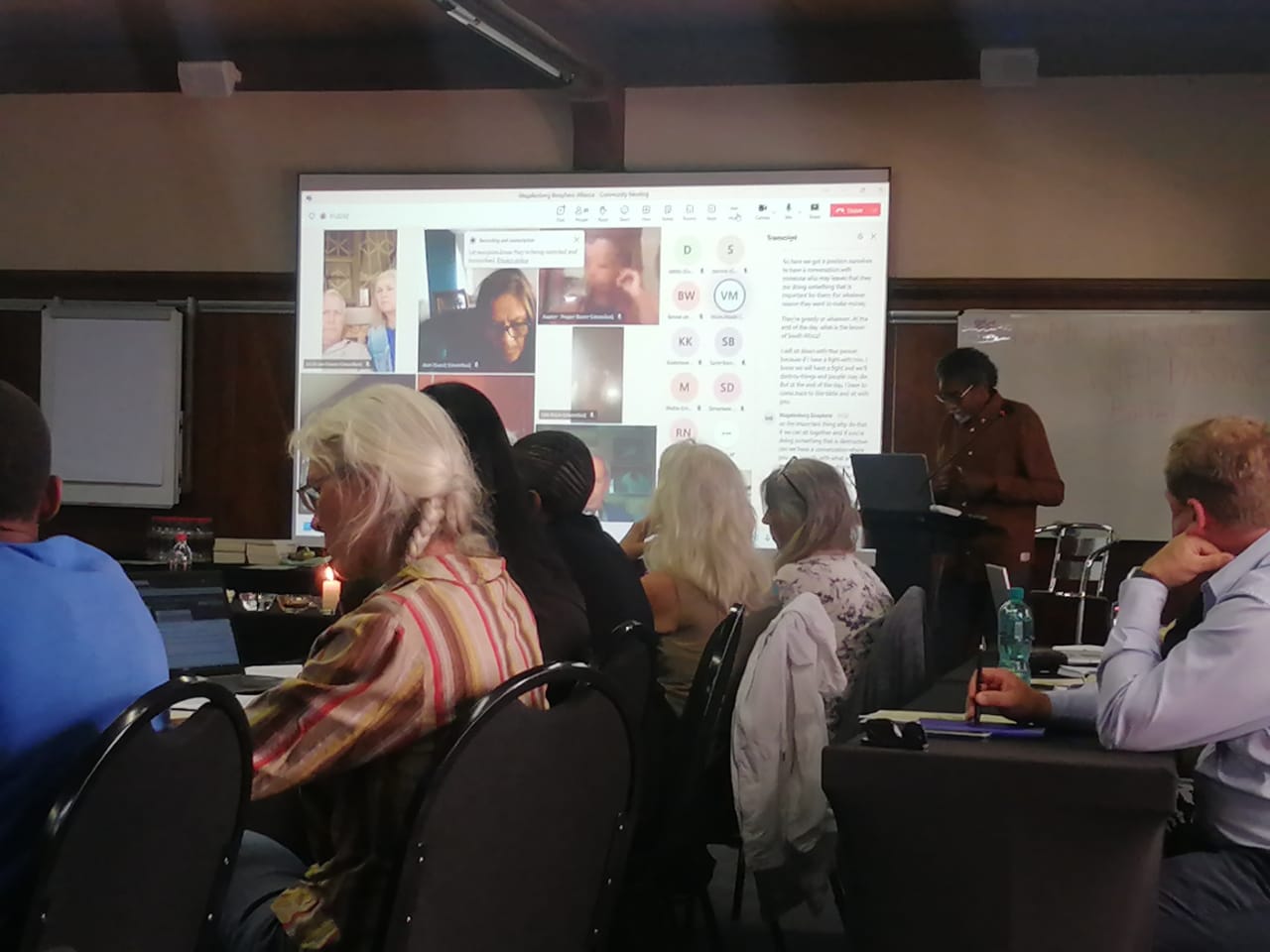
JPSS intervenes in this space as a neutral, third-party facilitator, with a clear mandate to restore dialogue, clarify roles and responsibilities, and shift stakeholders away from adversarial postures toward collaborative problem solving. Rather than reinforcing cycles of blame, the programme creates a platform for constructive engagement, one that emphasises shared responsibility and collective action.
Through structured dialogue processes facilitated by ISD personnel, or where necessary, through an independent panel of highly skilled facilitators, JPSS supports stakeholders to:
- Surface underlying issues and competing expectations
- Build mutual understanding of mandates and constraints
- Identify areas of common interest
- Co-develop practical, context-specific solutions
A key strength of the JPSS model lies in its ability to prevent escalation. By addressing disputes early and constructively, it reduces reliance on lengthy and costly legal processes, which often entrench divisions rather than resolve them. Instead, JPSS promotes win-win outcomes, where solutions are jointly owned and therefore more sustainable.
This approach represents a critical shift in how conflict is managed within development contexts. It recognises that lasting solutions cannot be imposed, they must be negotiated, understood, and collectively implemented.
In a country where inequality, resource pressures, and governance challenges continue to intersect, platforms such as JPSS are not merely facilitativethey are essential to advancing inclusive development and social cohesion.
A panel of professional advocates supported by regional field workers
The JPSS is delivered by a panel of professional advocates for dialogue, comprising trained and accredited mediators, facilitators, problem-solvers and drafters drawn from the labour, community and academic spheres. Each panellist is independent, vetted against the ISD’s governance processes.
The panel is supported in the field by ISD field workers based in each of the regions in which the Institute operates. The field workers act as the ISD’s neutral presence on the ground, supporting community engagement, dialogue logistics and the gathering of community evidence. Their regional positioning means JPSS engagements are anchored in lived community knowledge rather than parachuted in from outside.
Quote from the Programmes Manager
“The cost of conflict in mining communities is paid by everyone, by the operators who lose production, by the workers who lose income, by the communities who lose services and by government which carries the political weight. JPSS gives all four of these constituencies a structured way to sit down together with an honest broker in the room. We invite partners across the sector to engage with us on this offering. Our panel of professional advocates and our field workers are ready to support those who choose dialogue over escalation,” said Brown Motsau, Programmes Manager at the Institute for Social Dialogue.
An invitation to partners
The ISD invites mining operators, energy producers, industrial partners, organised labour, civil society, community formations, traditional leadership and government partners to engage with the Institute on JPSS. The ISD believes that structured social dialogue, anchored in evidence and protected by institutional neutrality, is the route by which mining-affected communities and the partners with whom they share their landscape can build a sustainable, equitable future.