Three kilometres underground, conditions are unforgiving. Rock temperatures climb beyond 40°C, geological stresses approach critical limits, blasting cycles introduce violent vibration and electromagnetic interference hums through every cable run. In these environments, seismic monitoring is not simply instrumentation, it is an operational safeguard. Early detection of micro seismic activity can provide crucial warning of stress redistribution, ground instability, or rock burst risk. When sensing systems fail, blind spots emerge precisely where visibility is most needed.
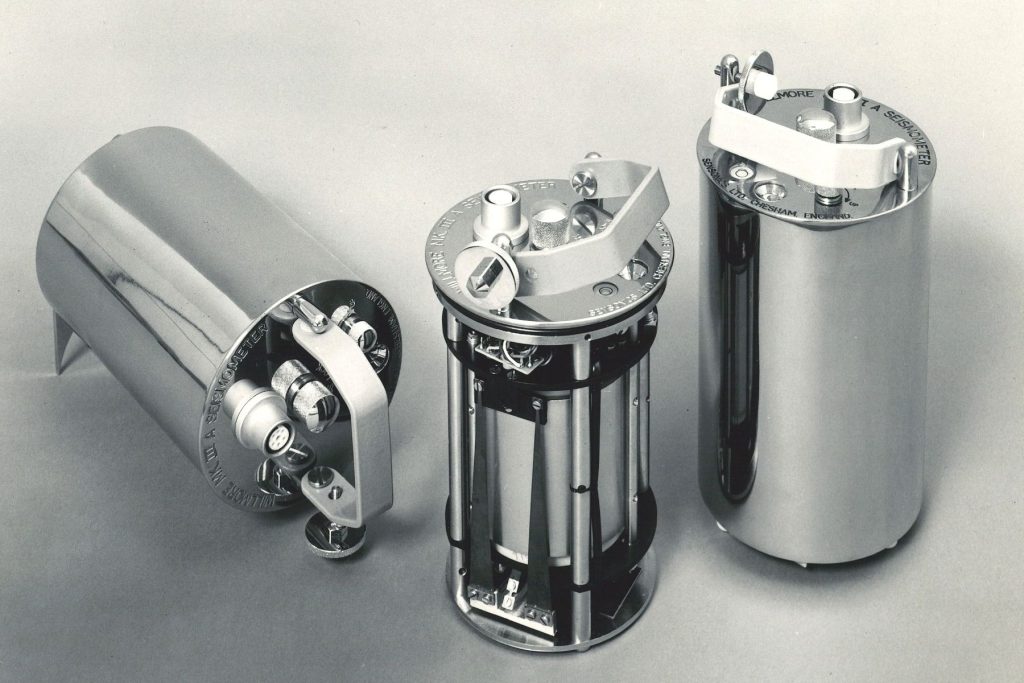
While broadband seismometers dominate regional monitoring networks, deep mining operations continue to depend on a quieter, highly practical workhorse, the adjustable-period moving-coil seismometer. Among the most widely deployed examples are the Willmore MkIIIA/FS and MkIIIA/S from condition monitoring specialists SENSONICS whose longevity owes less to novelty than to engineering discipline.
Engineering for the Realities of Mining
Deep hard-rock mining presents challenges rarely replicated in laboratory conditions. For example, persistent electromagnetic noise from heavy machinery, large-amplitude vibration from blasting, elevated and fluctuating temperatures, dust, moisture, and mechanical shock complex installation geometries. Under such constraints, theoretical performance offers limited reassurance, so survivability, linearity, and signal stability become decisive factors. The MkIIIA design reflects this reality and features at its core a suspended cylindrical magnet moving axially over twin coils arranged in a hum-bucking configuration.
Ground motion generates a velocity-proportional electrical signal, while the twin-coil arrangement actively suppresses electromagnetic interference. In electrically noisy underground environments, this noise rejection is not just a refinement but a necessity. Without it, low-level seismic signals risk being obscured by induced hum from nearby power systems.
Stability Under Stress
Mining-induced vibration can easily overwhelm sensors designed for gentler applications. During blasts or high-energy seismic events, instruments with limited mechanical range may clip or distort waveforms, degrading data quality when precision matters most. With a ±1.5 mm mechanical working range, the MkIIIA remains linear during significant vibration events, preserving waveform integrity across both micro seismic precursors and larger releases. This stability supports accurate event detection, waveform analysis, velocity measurement, and energy estimation, while reliability, in practice, is measured less by peak sensitivity than by consistent performance across extremes.
Performance Without Excess
Adjustable-period moving-coil instruments occupy a pragmatic niche between simple geophones and broadband systems.
| Parameter | Performance |
| Adjustable natural period | 1 – 3 seconds |
| Linear frequency Response | Up to 200 Hz |
| Mechanical working Range | ±1.5 mm |
| Output sensitivity | >400 V/m/s |
| Operating temperature | -40°C to +50°C |
This response profile aligns closely with the demands of local mine arrays, where detection of high-frequency micro seismicity, blast signatures, and stress-driven events is paramount.
One Sensor, Two Deployment Philosophies
Recognising the diversity of mine network architectures, Sensonics offers two connectivity options built around identical sensing performance.
MkIIIA/FS. Features a Fischer connector interface supporting cable runs up to 100 metres. The modular design enables flexible sensor placement, particularly valuable in distributed arrays or borehole installations requiring amplifier separation.
MkIIIA/S. Eliminates the connector in favour of an integral flying lead and when amplifiers are installed nearby, this configuration reduces component cost without altering measurement capability.
The distinction is practical rather than technical, an acknowledgement that network design often dictates hardware preference.
Where Adjustable-Period Technology Excels
Micro seismic Monitoring – Adjustable response characteristics enable detection across a broad spectrum of mining-induced seismicity, from subtle precursor events to larger stress releases.
Blast Analysis & Vibration Control – Velocity-proportional output supports Peak Particle Velocity (PPV) measurement, delay sequence validation, and infrastructure vibration assessment.
High-Stress Rockburst Environments – Mechanical robustness and electromagnetic rejection preserve data continuity during precisely the periods when monitoring is most critical.
The Economics of Reliability
In local arrays, scalability matters as mines may deploy dozens, sometimes hundreds of sensors across evolving headings. Therefore, cost efficiency is essential, but so is measurement stability.
Frequent recalibration, premature failure, or noise-contaminated data impose operational penalties that rarely appear on initial procurement spreadsheets. Adjustable-period moving-coil instruments persist because they offer a compelling
balance. For example, durable mechanical design, stable long-term response in harsh environments and predictable performance often outweigh technological novelty.
Enduring Relevance
Mining continues its progression into deeper, more geotechnically complex ground. Monitoring demands intensify. Data fidelity remains non-negotiable. Despite rapid advances in sensing and analytics, there remains a critical role for instruments engineered explicitly for environmental resilience. Technology does not become obsolete simply because alternatives exist, particularly when it continues to solve practical problems reliably. In underground seismic monitoring applications, longevity is rarely accidental, it is earned through performance under pressure.
More at: https://www.sensonics.co.uk/mining-metals
Download Your Free Guide from Sensonics
For more about our condition monitoring solutions, download our product overview brochure.
For further information contact sales@sensonics.co.uk
Sensonics Ltd, Berkhamsted, Hertfordshire, UK. Tel: +44 (0) 1442 876833.