SKF blends innovation with proven expertise to enhance mill reliability and efficiency, delivering sustainable value for key customer in the heavy industry.
SKF South Africa integrated its advanced products, deep engineering know-how and specialised remanufacturing capabilities to deliver and install a new trunnion assembly on a horizontal grinding mill, significantly enhancing the reliability and efficiency of the mill, ultimately maximising operational performance for the customer.
One of South Africa’s foremost suppliers of construction materials, based in the south of Johannesburg, identified frequent housing misalignment in the mill trunnion assembly of their horizontal grinding mill and turned to SKF for a trusted solution.
The SKF Mechanical Fiels Services (MFS) and Engineering team promptly conducted a site visit to inspect the mill trunnion assembly, diagnose the source of the frequent housing misalignment and provide an SKF solution.
SKF Application Engineer, Nthavela Makondo explains: “The frequent housing misalignment, caused by a misaligned rockers or panna on the trunnion mill housing of the mill, was resulting in persistent and unwanted operational disruptions. During operation, the housing shifted, making contact with rotating components such as seals. This led to equipment damage, unplanned downtime and subsequent costly production losses for the customer.”
The rocker housing is a critical component of the trunnion bearing assembly in a horizontal grinding mill and is designed with rockers that move back and forth – hence its name. This rocking motion enables the assembly to shift axially, accommodating the thermal expansion of the trunnion during mill rotation and ensuring reliable mill performance
The SKF MFS and Engineer’s assessment determined that the trunnion mill housing was not economically viable to repair and recommended a complete replacement assembly to ensure long-term reliability and performance. The customer decided to approach several suppliers, including one of SKF’s Authorised Distributors, Citi Bearings, also headquartered in Johannesburg South, to obtain quotes for a new assembly. Confident in their long‑standing relationship with Citi Bearings, reinforced by prior successful collaboration, the customer placed the order without hesitation.
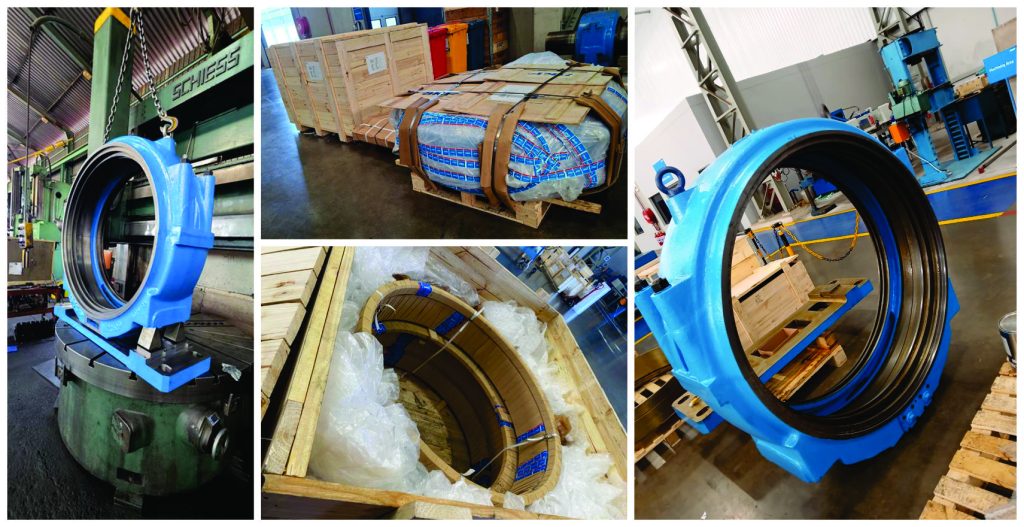
SKF supplied the complete rocker base trunnion mill housing assembly, complete with a Labyrinth (triple) seal and a 238/1180 CAK/C3W33 large size Spherical Roller Bearing. The solution also included an additional 238/1180 CAK/C3W33 bearing supplied as a spare for the customer’s future use.
“SKF was responsible for removing the existing bearing for potential remanufacturing and carried out all mechanical field services required for the bearing and housing replacement,” notes Makondo. “Installation was completed by the SKF MFS and Engineering team in collaboration with the Citi Bearings.”
The customer chose to retain the original design of the bearing assembly which, with drawings dating back as far back as 1969, was an established solution that has consistently delivered reliable performance over decades. “While SKF continues to deliver products built on advanced technology, our ability to meet specifications from drawings dating back more than 40 years underscores the SKF MFS and Engineering team’s unmatched competence and depth of experience,” highlights Makondo.
The new assembly delivered tangible benefits for the customer including improved equipment reliability and resilience, enhanced mill efficiency, reduced downtime and extended service life. “Moreover, the solution also expanded our service footprint and strengthened our partnership with our valued customer,” states Makondo.
SKF also added further value through the delivery of several sustainability benefits both for the customer as well as for the environment: Bearing remanufacturing reduces material consumption; improved mill efficiency and stable operation help to minimise emissions during use and reduce direct energy consumption, including that of supporting systems. “Most importantly, by mitigating the risk of seal damage and unexpected failures, the solution enhances both machine reliability and operator safety,” concludes Makondo.