

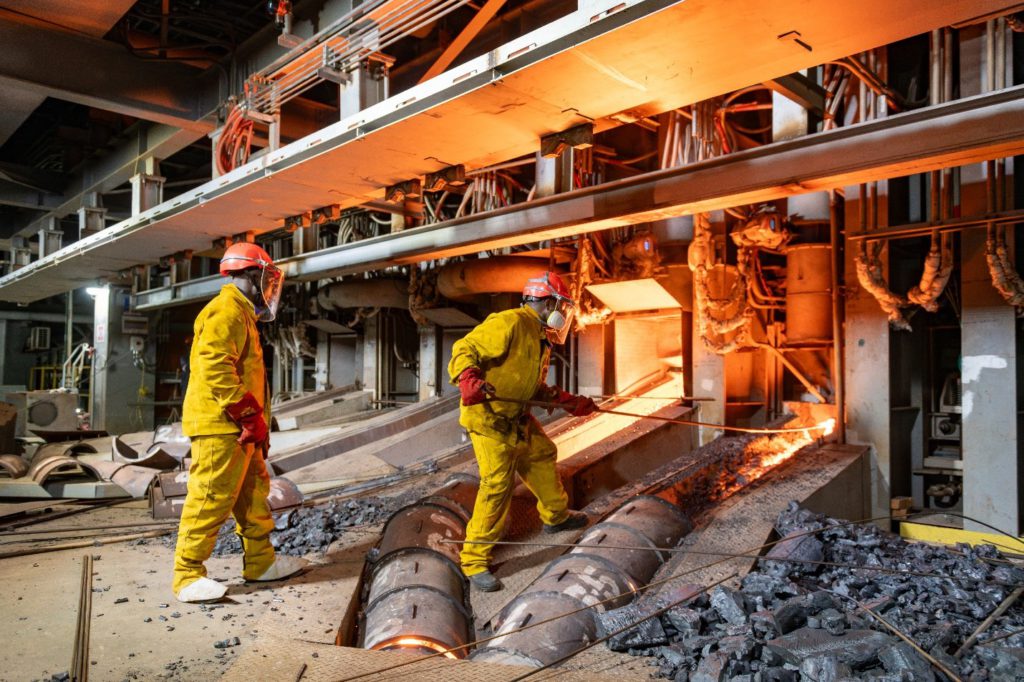
Canadian miner Ivanhoe Mines (TSX: IVN) has achieved a major milestone with the first production of copper anodes at its new direct-to-blister smelter at the Kamoa-Kakula complex in the Democratic Republic of the Congo.
The first batch of copper anodes was produced on Dec. 29, 2025, about five weeks after the smelter began heating up and just one week after the first concentrate was fed into the plant. Once the facility reaches full steady-state, it will be Africa’s largest copper smelter, with an annual capacity of 500,000 tonnes of 99.7 %-pure copper anode.
RELATED: Ivanhoe Mines: Africa’s Largest and Greenest Copper Smelter Has Commenced Heat-Up
Ivanhoe’s executive co-chairman Robert Friedland described the initial production as a defining moment for the project, highlighting the quality of the copper anodes and positioning the smelter as a new benchmark for efficiency and sustainability in global copper markets.
Following the announcement, shares of Ivanhoe Mines climbed as much as 5 % in Toronto trading, reflecting investor enthusiasm tied to the smelter’s ramp-up.
Smelter Ramp-Up and 2026 Outlook
The company is now progressing toward full capacity, with steady-state production expected by the end of 2026. In the meantime, Ivanhoe expects Kamoa-Kakula’s total copper output in 2026 to be between 380,000 and 420,000 tonnes, with the midpoint roughly equal to about 80 % of the smelter’s designed annual throughput.
Management plans to prioritize processing concentrates from its three on-site concentrators through the new smelter. Any surplus concentrate will be treated at the nearby Lualaba smelter near Kolwezi.
Before the smelter’s first concentrate feed, on-site inventory held roughly 37,000 tonnes of copper in concentrate. As the smelter ramps up, unsold inventory is expected to drop to about 17,000 tonnes in 2026, meaning overall copper sales could exceed production by around 20,000 tonnes as stockpiles are drawn down.