
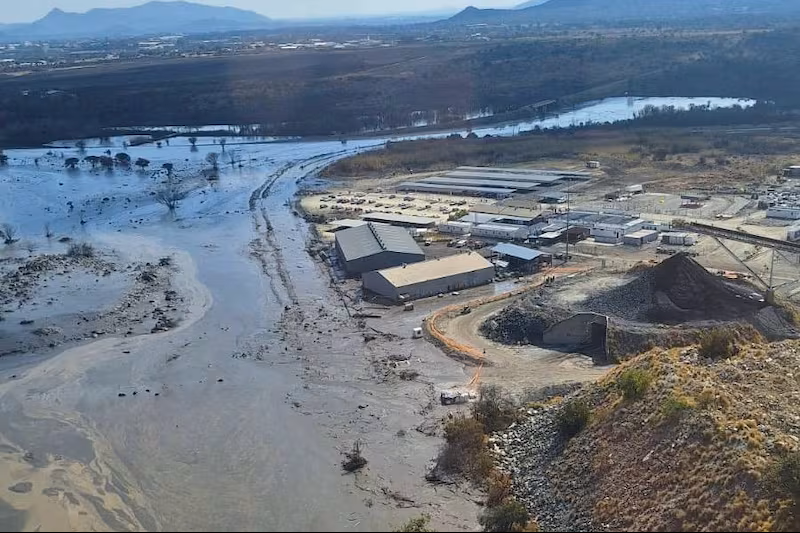
A tailings storage facility failure near Brits in South Africa’s North West province has highlighted the operational, infrastructure and environmental risks associated with the management of mine waste facilities.
The incident occurred on Thursday, 13 August, when a wall at the Samancor Dikwena tailings facility failed, releasing a large volume of mining waste towards the nearby Eland Mine, operated by Northam Platinum. The resulting flow of sludge affected access roads, damaged infrastructure and disrupted electricity supplies in parts of the surrounding area.
The incident has renewed attention on the importance of robust tailings storage facility design, monitoring and operational controls as South Africa’s mining industry continues to manage an extensive network of tailings facilities.


Infrastructure and operational disruption
The tailings flow crossed the R566 and reached areas around the Eland Mine, temporarily restricting access to an access road. Vehicles and other infrastructure were reportedly affected by the movement of the material, although the affected access route was subsequently cleared.
The incident also damaged electricity infrastructure operated by Eskom, contributing to power interruptions in Brits, Hennops and surrounding areas.
Eskom has indicated that its technical teams were working with the mine to gain access to affected electrical infrastructure and begin repairs. However, difficult ground conditions caused by the large volume of mud and sludge slowed the restoration process.
The incident demonstrates how a failure at a mining waste facility can extend beyond the immediate footprint of a mine. Damage to roads, electricity networks and other infrastructure can have consequences for neighbouring mining operations, businesses and communities.
Cause of failure remains under investigation
The precise cause of the tailings wall failure has not yet been established, with investigations continuing.
Analysis of satellite and rainfall data suggests that the failure did not occur during an immediate rainfall event. Available weather information indicates that the facility received approximately 4.2 mm to 4.8 mm of rainfall between 10 and 12 August.
While relatively modest, the rainfall was significant when compared with the historical August average for the area. Industry experts have suggested that water infiltration over the preceding days may have contributed to increased pore pressure within the tailings structure.
Another possibility being examined is the long-term structural condition of the facility and the manner in which material was deposited.
Tailings specialist Alastair Bovim has suggested that over-deposition may have contributed to a gradual weakening of the structure. Historical satellite imagery is also being examined to establish how the facility developed over time and whether hydraulic re-mining activities may have taken place in the area of the failed wall.
The findings of the investigation will be important in determining whether the failure was associated with operational practices, structural conditions, water management or a combination of factors.
Tailings management under renewed scrutiny
Tailings storage facilities remain one of the most significant risk-management issues facing the global mining industry.
Unlike conventional water-retention dams, tailings facilities contain finely processed mineral waste and water generated during mining and mineral processing. Their design and management therefore require careful consideration of factors including drainage, water levels, deposition rates, slope stability, pore pressures and long-term structural performance.
Major international incidents have demonstrated the potentially severe consequences when these systems fail.
The 2019 Brumadinho disaster in Brazil, for example, resulted in the deaths of hundreds of people and caused extensive environmental and economic damage. The disaster subsequently accelerated international efforts to strengthen standards governing the design, operation and closure of tailings facilities.
South Africa has also experienced serious tailings-related incidents, including the 2022 Jagersfontein disaster, which resulted in fatalities, damage to homes and significant disruption to the surrounding community.
These events have reinforced the need for mining companies to treat tailings management as a core operational and safety function rather than simply a waste-disposal requirement.
Importance of monitoring and governance
The incident near Brits also raises broader questions about accountability and governance across the lifecycle of tailings facilities, particularly where ownership, operation and historical use of a facility involve different companies.
According to reports, the Dikwena facility is situated on Samancor land but is operated by One Chrome, an unlisted company. Establishing clear responsibilities for the design, operation, inspection, maintenance and eventual closure of a tailings facility is therefore critical.
For mining companies, effective tailings management increasingly requires continuous monitoring rather than periodic assessment alone. Technologies such as satellite-based observation, remote sensing, instrumentation and digital monitoring systems can provide operators and engineers with earlier indications of changes in ground conditions, water levels or structural behaviour.
The integration of these technologies with conventional engineering inspections and robust emergency-response procedures can help operators identify emerging risks before they develop into major failures.
A wider lesson for the mining industry
The Dikwena incident serves as another reminder that tailings facilities are critical pieces of mining infrastructure and require the same level of engineering attention and risk management applied to processing plants, shafts, haul roads and other operational assets.
For neighbouring mines and communities, the incident also illustrates how the consequences of a tailings failure can extend well beyond a facility’s boundaries.
As South Africa continues to develop its mineral resources and maintain mature mining operations, the effective management of tailings will remain central to maintaining safe, resilient and socially responsible mining operations.
The immediate focus will now be on determining why the Dikwena facility failed, assessing the extent of the environmental and infrastructure impact, and ensuring that appropriate remedial measures are implemented.
The outcome of the investigation should provide valuable lessons not only for the operators directly involved, but for the wider mining sector as it works to strengthen tailings governance, monitoring and long-term risk management.