SKF South Africa demonstrated the power of its remanufacturing expertise, delivering a rapid turnaround of just eight weeks on four critical bearings operating on a High Pressure Grinding Roll (HPGR) for a longstanding key customer. In addition to minimising downtime and production losses, this accelerated response also provided significant savings for the customer, cutting costs by a staggering 50%, underscoring the tremendous value SKF brings through its innovative remanufacturing services. Notably, this achievement marks the first component replacement reman Service Level of its kind in Africa, successfully completed by SKF.
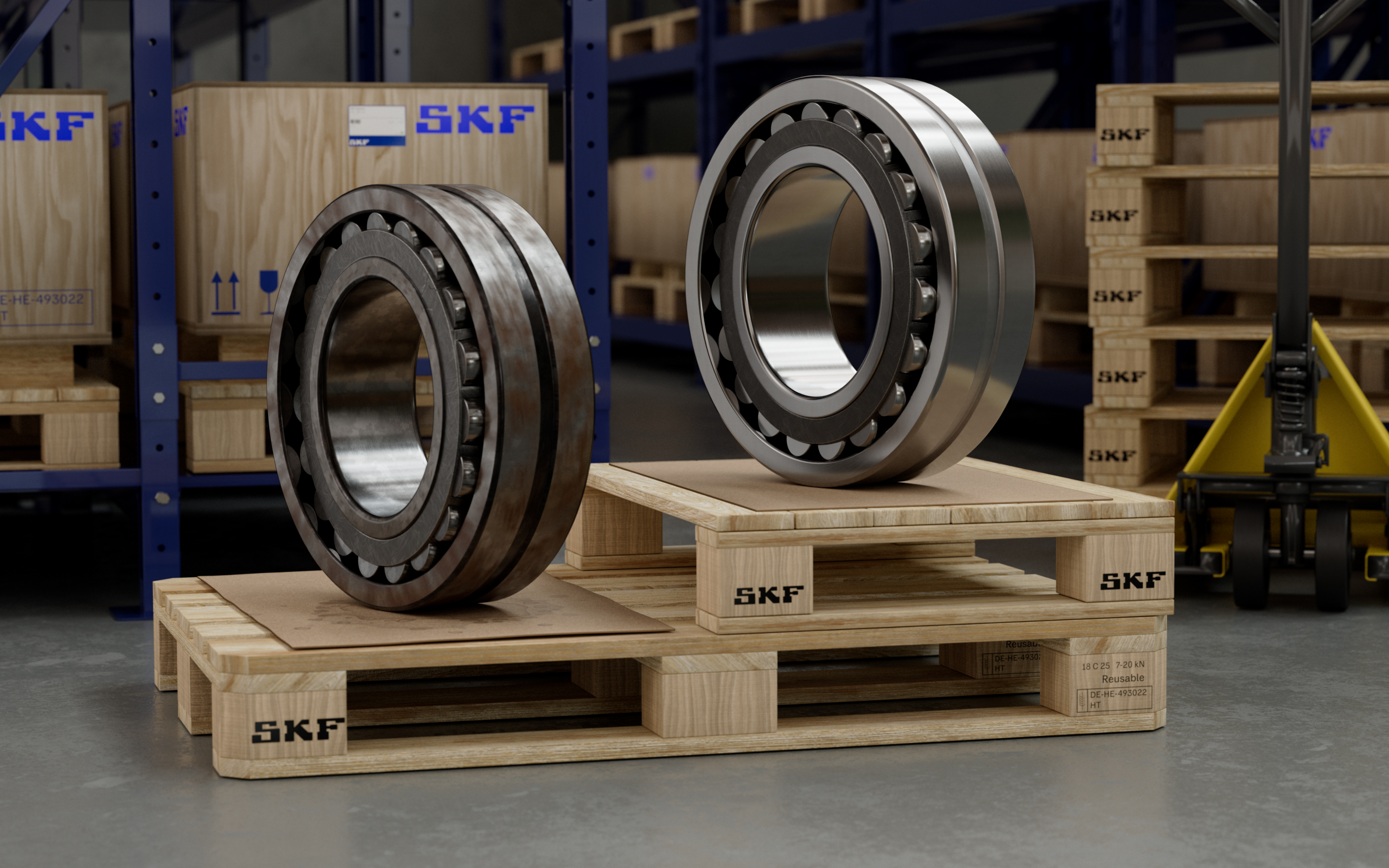
The customer, a prominent supplier of equipment, technology and services to the mining sector, has long relied on SKF’s products including bearings, lubrication systems supported by remanufacturing expertise, advanced condition monitoring and mechanical field services, to keep operations running reliably. HPGRs operate under immense pressure to crush material in the mining process which puts a great deal of strain on the bearings. When four large size 240/800 ECAK30/C4L bearings on the HPGR required Remanufacturing, the customer placed their trust in SKF to deliver a specialist solution.
SKF South Africa established a specialist Bearing Remanufacturing facility in 2008 at its Jet Park head office in Johannesburg, with several clear objectives in mind. Foremost was the drive to deliver customer value. The centre extends the life of high value bearings through second, third and even fourth use, with Remanufactured units typically costing roughly up to half the price of new bearings. Equally important for SKF is environmental responsibility. By reusing rather than replacing bearings, customers benefit from reduced costs and shorter lead times while actively contributing to a greener planet. Beyond lowering material consumption, SKF South Africa ensures that bearings not eligible for remanufacture are recycled, effectively closing the loop and reinforcing sustainability as a defining principle of its operations. “In essence, every bearing and unit we Remanufacture meets the same stringent quality specifications as new SKF products, underscoring the company’s role as a global sustainability leader,” says SKF Service Delivery Manager, Lourens Pretorius.
“While we have Remanufactured large-size bearings for the customer in the past, we have never replaced components on a bearing before,” observes Pretorius. The customer urgently needed the HPGR to be operational again as soon as possible. However, new bearings typically require a manufacturing lead time of around six months, Due to the criticality of the repair, the quickest and best solution was to replace the rolling elements in all four bearings with oversized rollers to get our customer operational as soon as possible.”
Pretorius explains the critical role of radial internal clearance in bearing Remanufacturing. “When a bearing arrives for Remanufacture, the team first measures its radial clearance to determine what the final clearance parameters would be after the completion of the process. Radial internal clearances are typically classified into ranges: C3 indicates greater than normal clearance while C4 is bigger than C3 and so on. They can further indicate where in the clearance range the actual radial internal clearance is; for example, C4L denotes the lower part of the C4 range whereas C4H marks the higher end. This precise measurement provides valuable insight into the bearing’s condition and guides the Remanufacturing approach. If the clearance is on the upper level, the chances are high that the bearing clearance will increase a class due to the removal of the bearing material.” Pretorius underscores that this meticulous attention to clearance not only ensures precision in Remanufacturing and subsequent bearing life longevity but also reinforces SKF’s commitment to extending bearing life responsibly, aligning technical excellence with sustainability.
According to Pretorius, in this specific case, all four bearings already had clearances within the C4H range and would have gone into the C5 clearance range following standard Service Level 3 (SL3) Remanufacturing process. “This is why, to mitigate this issue, the rolling elements were substituted with oversize rollers to control the bearing’s radial internal clearance. This method enabled the bearings to be Remanufactured and adjusted to C3 clearance within an eight-week period.” “By implementing Service Level 4 (SL4) Remanufacturing, SKF was able to replace critical components such as the rollers and/or cage and guide ring, ensuring the bearing was fully restored.
SKF and the customer are jointly managing after market support on the Remanufactured bearings, including servicing, repairs and maintenance, ensuring reliable performance and continuity throughout the bearing’s lifecycle for smooth, uninterrupted operations.
By keeping customer downtime to just eight weeks instead of the standard six months through bearing Remanufacture, SKF South Africa significantly minimised downtime and production losses. In addition, the 50% cost saving delivered to the customer and the extended service life that lowers Total Cost of Ownership by extracting more value from each bearing, reinforces the value proposition of SKF’s Remanufacturing solutions.
As SKF South Africa’s first successful component replacement Remanufacturing order, this milestone project marks a breakthrough achievement for both SKF South Africa and its customers, aligning sustainability and shorter lead times with world class engineering. Beyond the operational gains, the Remanufacturing project’s success underscores SKF’s commitment to environmental responsibility, reducing carbon footprints and conserving raw materials. This defining success strengthens customer partnerships and also demonstrates SKF South Africa’s Remanufacturing excellence and leadership in driving sustainable industry transformation on the continent.
For more information please visit : skf.com