Compressed air drives operations across virtually every sector at scale, securing its status as the ‘fourth utility’. Yet this vital utility is also one of the most energy-intensive systems in a plant, consuming up to 90% of total energy. Compressed air systems therefore present a strategic opportunity for manufacturers seeking to reduce operational costs and meet economic and environmental sustainability targets.
“Efficiency starts with smart equipment and advanced integrated technologies,” says Saien Rugdeo, Atlas Copco Compressor Technique’s Sales Manager – CSO (Customer Services and Optimisation). “Customers can cut energy consumption by up to 60% by upgrading to energy-efficient solutions like variable speed drive (VSD) compressors for example. Further savings can be unlocked by optimising system pressure and eliminating air leaks, ensuring energy is used efficiently and not wasted.”
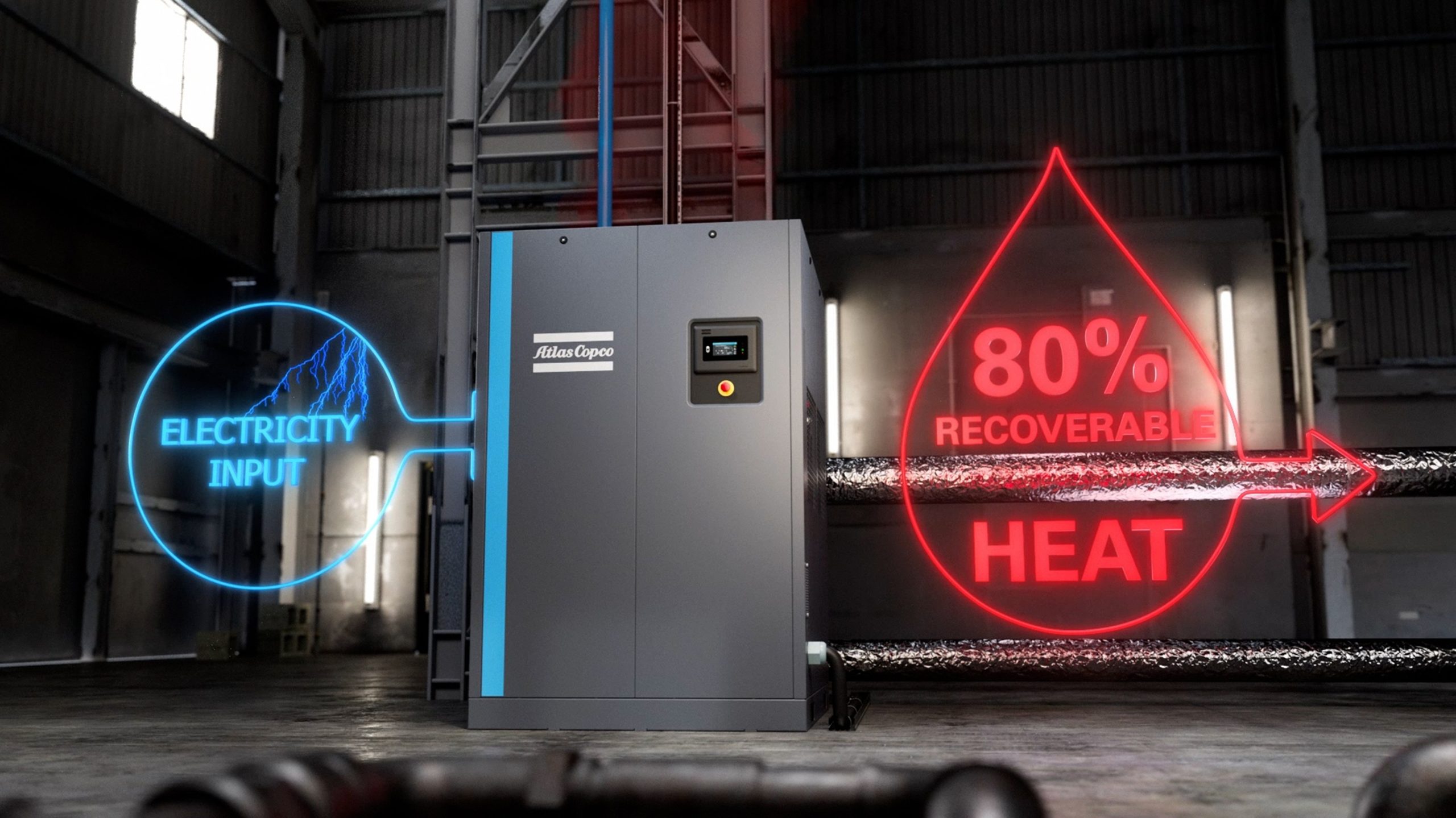
“As manufacturers push for increasingly deeper efficiency gains, we’re seeing growing interest in a transformative yet often overlooked resource – the untapped power presented by waste heat,” says highlights Rugdeo. “Compressing air generates significant heat. In fact, most of the electrical energy consumed by a compressor is converted into thermal energy. Without recovery systems, this relentless stream of heat simply vanishes into the atmosphere – unseen, untapped and costing businesses dearly. By adding waste energy recovery technology to a compressed air system, manufacturers unlock a game-changing opportunity; they can reclaim much of the energy consumed during compression, transforming a costly by-product into usable energy that drives greater efficiency and delivers measurable savings.”
To harness this untapped potential, Atlas Copco offers an Energy Recovery system, a solution that turns waste into value. The Energy Recovery system relies on an integrated heat exchanger to capture most of this waste heat for reuse, either as hot air via ducting connected to the compressor or as hot water using a water supply connected to the compressor.

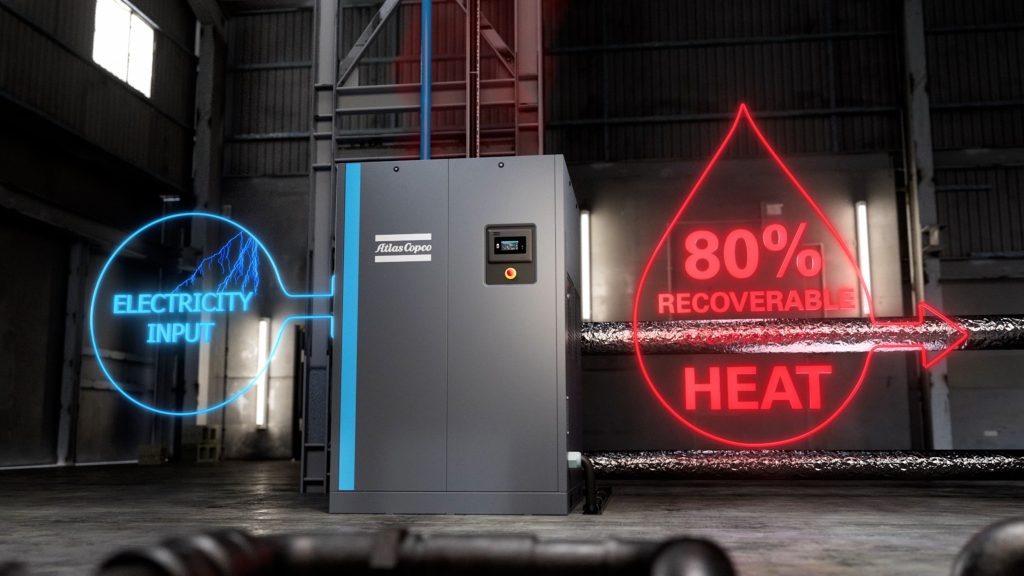
Rugdeo notes that, depending on the configuration, the system can recover up to 94% of the heat generated during compression, either as hot air or hot water. The recovered energy can be repurposed across a wide range of applications, from laundries, space heating and hot water or steam generation to industrial processes such as automotive and chemical refining, pharmaceutical drying and sterilization, food and beverage pasteurization and cleaning, textile dyeing, and electronics clean room sterilization. “This solution drives immediate, measurable improvements and tangible gains, boosting energy efficiency, cutting operational costs, and reducing carbon emissions,” affirms Rugdeo.
Atlas Copco’s Energy Recovery systems are delivering tangible results for manufacturers across industries, especially those focused on boosting efficiency, cutting costs and reducing carbon emissions. One such example is a leading food producer that partnered with Atlas Copco to assist in meeting their ambitious, SBTi-aligned sustainability goals.
Faced with the challenge of reducing boiler fuel consumption to shrink its carbon footprint, the food manufacturer engaged Atlas Copco for a targeted solution. Following an energy assessment, Atlas Copco proposed a waste heat recovery system that would enable the customer to reclaim thermal energy from its compressed air system and redirect it into boiler operations, significantly reducing reliance on fossil fuels and achieving substantial CO₂ savings.
The first Energy Recovery unit, installed on a GA160 compressor, delivered immediate results for the food manufacturer. Within just six months, it achieved energy savings of 208,000 kWh, reduced CO₂ emissions by a remarkable 42 tons and cut costs by $152,600, reaching full payback in under six months.
The success of the initial installation prompted the customer to gradually scale up their Energy Recovery setup and currently five Energy Recovery systems operate across five GA160 compressors at the food producing facility. The most recently installed unit is equipped with SMARTLink, Atlas Copco’s real-time monitoring platform, which accurately tracks energy consumption and CO₂ emissions, enabling the customer to validate performance and report on sustainability metrics with confidence. The cumulative annual impact across all five units now delivers 2,080,000 kWh in energy savings, a reduction of 420 tons of CO₂, and an estimated $152,600 in cost savings. These results not only advance the customer’s sustainability goals but also deliver a compelling return on investment.
Before investing in an Energy Recovery system, Rugdeo stresses the importance of understanding compressor types to select the right solution. “Air-cooled compressors offer a straightforward, cost-effective retrofit, even for smaller units,” explains Rugdeo. “In contrast, water-cooled compressors often require added infrastructure like pumps, heat exchangers and control valves, making Energy Recovery economically viable primarily for units above 22 kW.”
Rugdeo further notes that the savings potential of an Energy Recovery system depends on several key factors including compressor type and size, operating hours, cooling method, and the design of the compressed air system. “Practical opportunities for heat reuse within the plant, along with the facility’s ability to repurpose recovered energy, also play a critical role,” he explains.
“In short, when the right conditions align, Energy Recovery is a smart investment that sustainably fast-tracks operational efficiency, cost savings and carbon reduction. With rapid returns on investment, often under a year, Energy Recovery systems offer a compelling pathway for manufacturers to meet sustainability targets while strengthening their bottom line,” concludes Rugdeo.
For more information visit: Atlas Copco